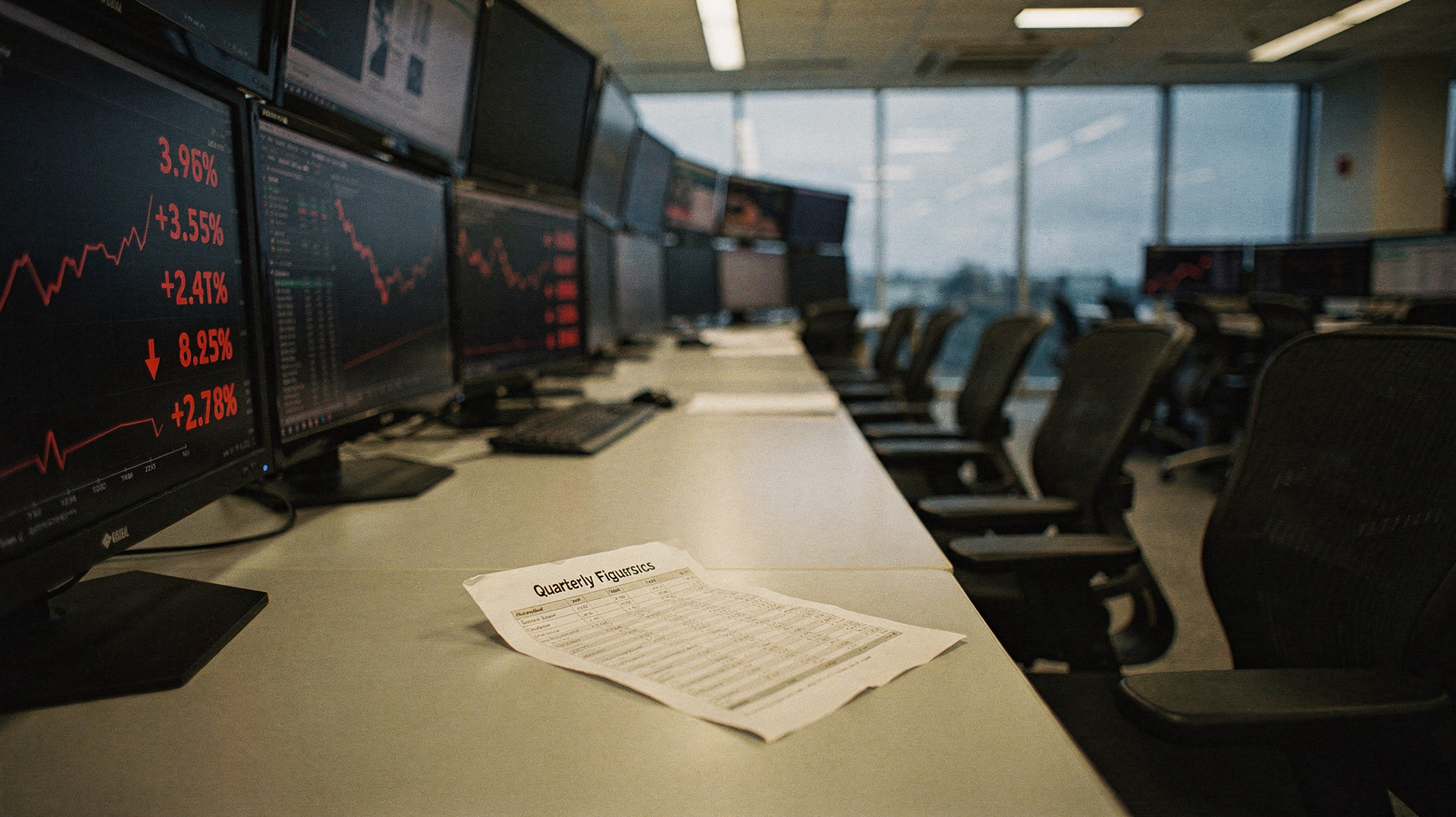
Global AI and semiconductor stocks shed more than $1 trillion in market value this week, with the selloff deepening on October 15. SK Hynix fell more than 10% in Seoul, Samsung about 9%, ASML roughly 6.6% in Europe; Nvidia, AMD, Micron and Infineon fell alongside them. One semiconductor index has given back about $1.6 trillion across six consecutive losing sessions. The decline came even as the companies reported the best numbers in their history.
The contradiction is the story. On the same morning the selloff deepened, TSMC reported third-quarter net profit of NT$763.1 billion — about US$23.6 billion, up 68.7% year over year and ahead of analyst expectations — with revenue up 50.9%. High-performance computing accounted for roughly 68% of that revenue. Demand for AI accelerators has not slowed. What has changed is what investors are willing to pay for the certainty of it.
Earnings Up, Prices Down
When strong results fail to lift a stock, the market is no longer pricing the present. It is pricing the financing. The immediate trigger was a hotter-than-expected US inflation reading, which raised expectations of further rate increases and, with them, the cost of borrowing to build data centers. Layer on a crowded trade — Samsung and SK Hynix had risen roughly 150% and 250% over the prior year — and the selloff is less a verdict on AI than a repricing of how it gets paid for.
The question stopped being whether the chips sell. It became who is holding the debt that buys them.
That question has a name this week: CoreWeave. Its plunging shares and weakening bonds revived concern about the financial sustainability of the buildout, because CoreWeave is the purest listed proxy for debt-financed AI compute. If the returns on rented GPUs are thinner than the interest on the loans that bought them, the arithmetic does not care how good the models are. The market is now doing that arithmetic out loud.
The Memory Squeeze
There is a second pressure specific to the memory makers. Reports that China’s CXMT is advancing a competing memory architecture hit Samsung and SK Hynix hardest, precisely in the high-bandwidth segments where their margins are fattest. High-bandwidth memory has been the quiet bottleneck of the whole AI buildout — the component that decides how fast a training cluster can feed its accelerators. A credible domestic Chinese alternative does not need to match the leaders on quality to matter; it only needs to cap their pricing power.
Set that against the export-control picture and the week reads as a stress test of the assumption underneath the entire trade: that demand for compute is effectively unlimited and supply is the only constraint. Nvidia’s data-center share in China has already slipped to 34% as Huawei reached 28%, and Washington and Beijing are reportedly exploring cooperation ahead of a planned leaders’ meeting. Every one of those threads pulls on the same question — how much of the demand is durable, and how much was the price of scarcity.
What the Floor Is Saying
None of this means the AI buildout is ending. TSMC’s numbers, and its sixth consecutive quarter of record profit, say the opposite: the physical demand is real and growing. What the selloff says is that the market has begun to separate the companies that make things from the companies that finance the making of things, and to price them differently. The chipmakers still sell every wafer they can produce. The question the market is now asking is whether the customers can keep affording to buy them.
For anyone building on this infrastructure, the practical read is unglamorous. Compute has been priced as if capital were free. If the cost of capital is repricing, so is the cost of compute, and the era of treating GPU hours as an unlimited resource may be closing faster than the model releases suggest. The next few quarters will show whether this was a correction inside a boom or the first crack in one.
The Takeaways
- Global AI and semiconductor stocks lost more than $1 trillion in market value this week, with the selloff deepening on October 15.
- SK Hynix fell over 10%, Samsung about 9%, and ASML roughly 6.6%; Nvidia, AMD, Micron and Infineon also declined.
- The rout came despite record results: TSMC reported Q3 net profit up 68.7% year over year, with high-performance computing at about 68% of revenue.
- Drivers include a hotter US inflation reading, doubts about debt-funded AI infrastructure returns, crowded valuations, and reports of Chinese memory competition from CXMT.
- CoreWeave’s falling shares and weakening bonds revived concern about the financial sustainability of the AI buildout.