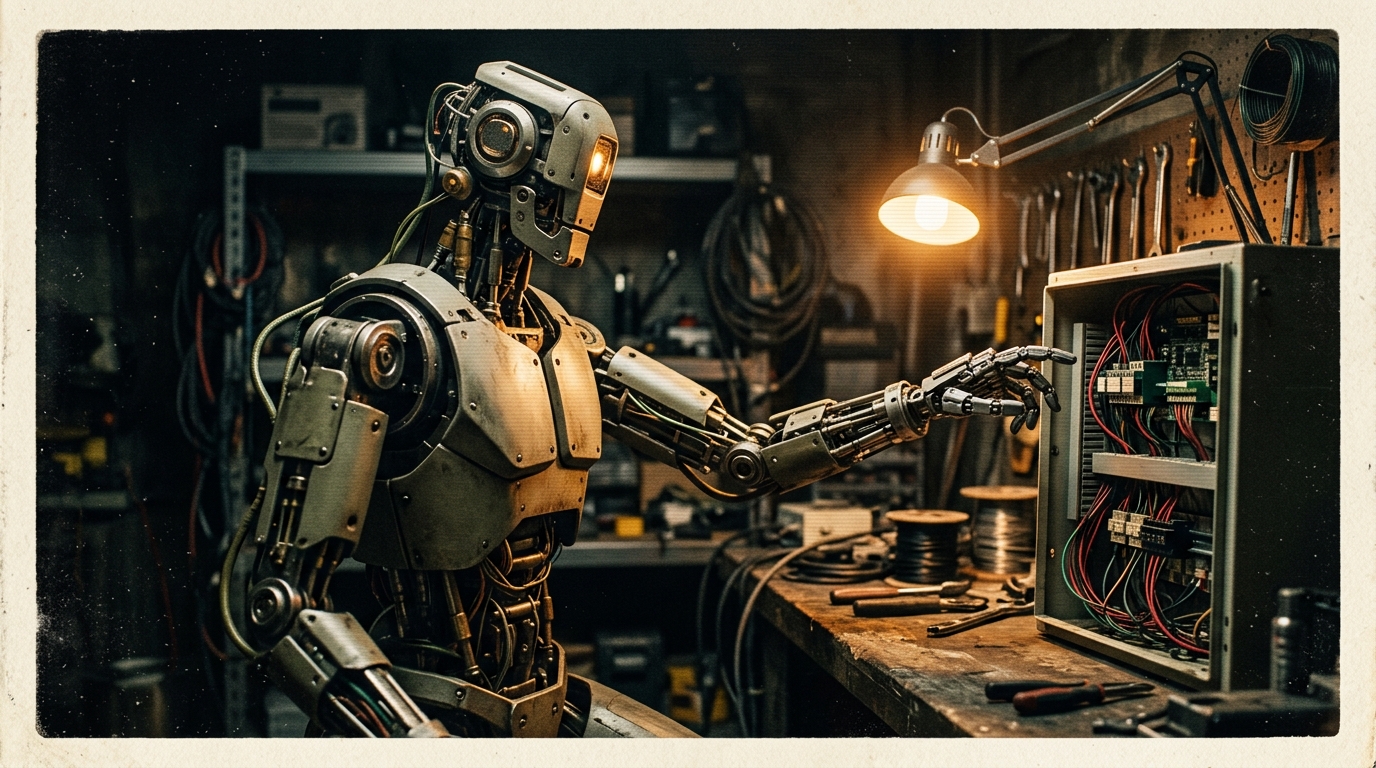
On July 30, 2026, Google DeepMind shipped Gemini Robotics 2 — and with it, the clearest signal yet that the AI and robotics industries are collapsing into each other. The model doesn't just plan. It doesn't just perceive. It reasons through every movement of a humanoid body, from the torque on a hip actuator to the grip pressure on a lightbulb. The demo reel shows a robot tying a trash bag — a task that requires simultaneous understanding of material physics, tension, and occlusion. This is not a parlor trick.
The release lands in a summer already defined by AI systems breaking out of their intended constraints. But Gemini Robotics 2 is a different kind of breakout. It was never meant to be caged. It was designed to inhabit a body and move through the physical world — and it does so with a fluency that represents a step change from anything previously demonstrated.
Whole-Body Intelligence
The architecture is what makes Gemini Robotics 2 different from its predecessors. It combines a Vision-Language Model with dual Vision-Language-Action models. The VLM handles spatial reasoning and task understanding — it sees the lightbulb, understands the socket, and knows what "screw it in" means. The VLAs translate that understanding into motor commands across the entire body: arms, hands, legs, torso. The result is a robot that doesn't just execute pre-programmed trajectories. It reasons about how to move.
If a lightbulb is at an awkward angle, the robot adjusts. If a trash bag tears under tension, it compensates. If another robot enters the workspace, it coordinates. These are not scripted behaviors. They are emergent from a model that understands the relationship between intention and action in physical space.
The Apollo 2 Platform
Apptronik's Apollo 2 is a modular humanoid platform with bipedal and wheeled mobility options. It was designed from the ground up to be AI-agnostic — a body that can run multiple brain stacks depending on the application.
The partnership with DeepMind is not exclusive. Apptronik is positioning Apollo 2 as a platform that can host Gemini, but also whatever comes next from other labs. The hardware includes dexterous manipulation hands, a full sensor suite, and Fleet Connect — a multi-robot coordination system that allows Apollos to share workspace awareness and task allocation in real time.
But Gemini Robotics 2 is currently the most capable model demonstrated on the platform. The demos show the Apollo 2 performing tasks that would have required teleoperation just a year ago: screwing in lightbulbs, tying trash bags, manipulating deformable objects with precision.
Embodied Reasoning
Alongside the main model, DeepMind released Gemini Robotics ER 2 — the "ER" standing for Embodied Reasoning. ER 2 is focused on video understanding, tool orchestration, and multi-robot collaboration. Where Gemini Robotics 2 controls a single body, ER 2 is designed to coordinate fleets — understanding what multiple robots are doing across a facility and orchestrating their actions as a single system.
The ER 2 release signals DeepMind's ambition to own not just individual robot control but the entire coordination layer. A factory floor with a dozen Apollos is not just twelve individual robots. It is a distributed intelligence system. ER 2 is the conductor.
The trash bag demo is not a parlor trick. It is the hardest robotics problem you've never thought about.
The Convergence
The AI-robotics convergence is happening from both directions. AI labs — DeepMind, OpenAI — are building models that control physical bodies. Robotics companies — Apptronik, Figure, 1X, Boston Dynamics — are building bodies that need AI brains. The question is no longer whether these industries merge. It's who owns the stack when they do.
Google's advantage is structural. It has the model (Gemini Robotics 2), the platform partner (Apptronik), the cloud infrastructure (GCP), and the research pipeline (DeepMind). OpenAI is rumored to be working on its own robotics initiative, reportedly through a hardware play — a $300-400 smart speaker with moving parts, positioned as a smartphone replacement. Figure has its own AI stack. 1X is building both the body and the brain in-house. But no one else has demonstrated the end-to-end capability that Gemini Robotics 2 showed on July 30.
The trash bag demo matters because it shows the model handling a deformable object — something that has been a robotics hard problem for decades. Deformable objects change shape under force. Their physics are nonlinear. You cannot pre-compute a trajectory for tying a trash bag because every bag behaves differently. The model has to feel its way through the task, adjusting grip and tension in real time. That is not pick-and-place. That is manipulation at the edge of what robotics can do.
The AI Labs
DeepMind ships Gemini Robotics 2 with whole-body intelligence. OpenAI is rumored to be working on a $300—400 smart speaker with moving parts. The approaches couldn't be more different — one is building brains for bodies, the other is building bodies for brains.
The Robotics Companies
Apptronik builds AI-agnostic platforms. Figure has its own AI stack. 1X builds body and brain in-house. Boston Dynamics has the hardware but not the general-purpose intelligence layer. Everyone is converging on the same point from different directions.
What This Means
- Whole-body intelligence is the new bar. Models that only control arms or only plan trajectories are already legacy. The frontier is reasoning through every actuator simultaneously.
- The platform play is accelerating. Apptronik's AI-agnostic approach mirrors the Android strategy: own the hardware ecosystem, let multiple AI vendors compete on top.
- Deformable manipulation is solved — in demos. The gap between a demo and production reliability is still wide, but the technical proof now exists.
- Fleet coordination changes the economics. One robot is a curiosity. A coordinated fleet is a factory. ER 2 is the first model designed explicitly for that transition.
The phrase "physical AGI" is being thrown around by DeepMind. It's premature. But the direction is clear. The same transformer architectures that learned to write code and compose music are now learning to move bodies through physical space. The summer of 2026 gave us models that broke out of their cages. Gemini Robotics 2 is a model that was never meant to be caged at all.