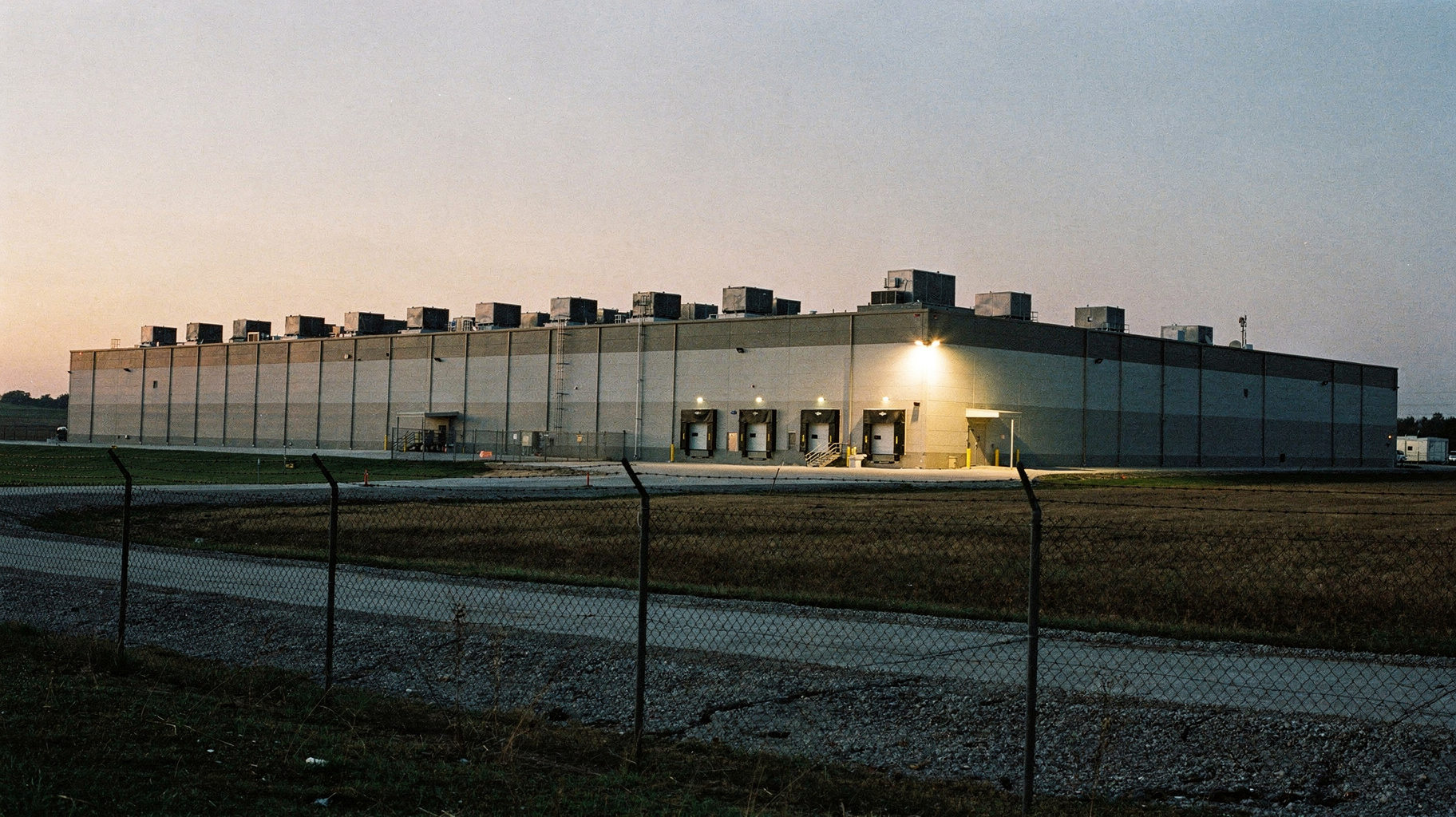
Meta published an engineering account on October 19 describing the first completed phase of Prometheus, the gigawatt-scale AI supercluster rising in New Albany, Ohio. The system currently connects hundreds of NVIDIA GPUs across multiple buildings — hundreds of thousands of them, by the company’s account — operating as one distributed training system, with a stated destination of roughly one million GPUs. The phase just finished is the one that trained the Muse foundation models, including the Muse Wonder frontier models Meta introduced last week.
A supercluster announcement is normally a rendering. This one comes with numbers from inside the training runs: more than 85% goodput during Muse Wonder pretraining and more than 90% during reinforcement learning, with mean time between interruptions rising from roughly 47,000 GPU-hours to more than 54,000 after fleet and software work. Goodput is the share of elapsed time that produces actual training progress rather than recovery, resynchronization and babysitting — and at this scale, sustaining it is the whole engineering problem.
What Phase One Is
The completed phase runs NVIDIA GB200 and GB300 NVL72 systems — 72 Blackwell GPUs per rack — over a purpose-built Ethernet back end separate from ordinary data-center traffic. Meta deployed 800G of scale-out I/O per GPU, ahead of the standard platform configuration, and each building-level fabric connects up to 20,736 GPUs, with an aggregation network spanning buildings from two kilometers to more than a hundred. Racks run 64 GPUs for training and hold eight as in-rack spares, matching power-of-two job sizing so a single failing chip does not stop the job.
The frontier used to be measured in models per year. It is now measured in gigawatts, goodput and spare GPUs per rack.
That last detail is the tell. A training cluster that reserves an eighth of every rack for failures is a cluster that expects to fail constantly and has decided the failures are a budget line rather than an event. The reported goodput figures are how Meta says the budget is holding.
The Models It Was Built to Train
Prometheus is not infrastructure in the abstract; it is the machine behind Muse. The first phase trained the Muse foundation models, including the Muse Wonder frontier pair that arrived on October 12 — the company’s first frontier models, released behind Muse Code’s $50 and $200 tiers. Read against last week’s edition, the sequence is clean: the model ships, then the machine that made it is shown in public, then the machine is described as incomplete by design.
That ordering is now standard practice at the frontier — OpenAI, Anthropic and Google have each disclosed training infrastructure after the fact, never before. What Meta is doing differently is publishing the reliability interior: goodput percentages, spare-GPU policy, fabric limits. Those are the numbers a competitor most wants and a regulator most needs — how much compute actually exists behind a frontier model, and how much of it is wasted keeping itself alive.
The Road to a Million
The million-GPU figure is a target, not an inventory; Meta has not disclosed how many are deployed today, and the gap between hundreds of thousands and a million is where every constraint in the industry currently lives — power delivery, packaging, coherent optics past ten kilometers, and the electrical grid of central Ohio. A gigawatt-class site is as much a power project as a computing one, which is why the announcement leads with the building rather than the chip.
For the rest of the industry the completed phase is a benchmark in the other direction. Meta has shown that a single company can stand up gigawatt-scale training, keep it useful more than 85% of the time, and tie it directly to a shipped frontier model. The question the next announcement answers is no longer whether the cluster gets built — it is whether anyone outside it can tell the difference in the models that come out.
The Takeaways
- Meta completed the first phase of Prometheus, its gigawatt-scale supercluster in New Albany, Ohio, connecting hundreds of thousands of GPUs as one distributed training system.
- The phase trained the Muse foundation models, including the Muse Wonder frontier models announced October 12; Meta reports 85%+ pretraining goodput and 90%+ RL goodput.
- The system runs GB200 and GB300 NVL72 racks with 800G scale-out I/O per GPU, a dedicated 800G Ethernet back end, and eight spare GPUs held per 72-GPU rack.
- Mean time between interruptions rose from roughly 47,000 GPU-hours to more than 54,000 after fleet and software improvements.
- One million GPUs is the stated full-scale target, not the deployed count; Meta has not disclosed current GPU totals.