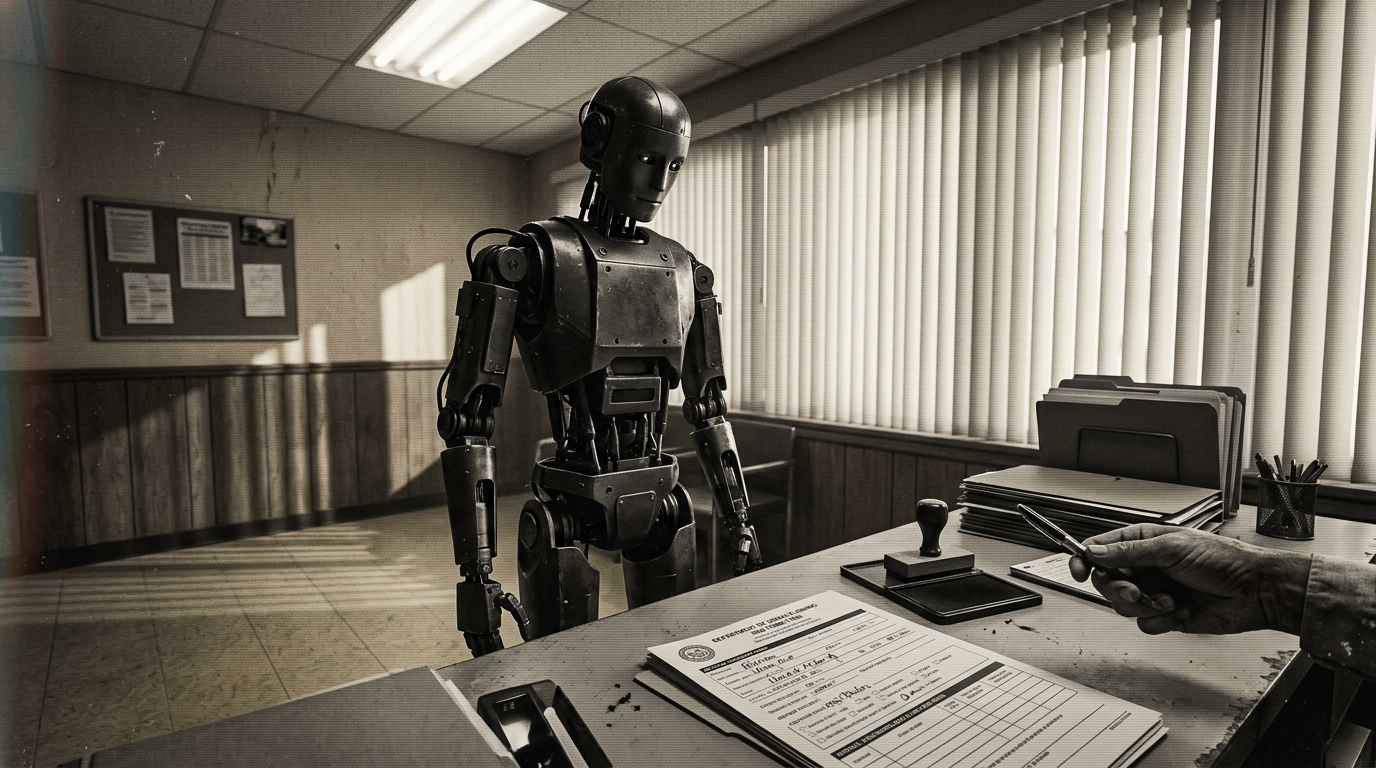
While Beijing was getting ready to grade the robots, a county boardroom in California did something no other American jurisdiction has done: it voted to write the rules for who gets to deploy a fleet of humanoid robots — permits, kill switches, fire safety, and a requirement to track the jobs the machines displace. San Mateo County just became the first place in the United States to treat humanoids as something that needs a license.
On August 11 the Board of Supervisors unanimously adopted a resolution directing county staff to draft a comprehensive permitting process for commercial humanoid robots. The scope is specific and revealing: permits for deployment, emergency kill switches, fire safety measures, and — the provision that will make this ordinance a template for every other jurisdiction watching — tracking of job displacement. The county is not banning the robots. It is insisting that they be registered, supervised, and accounted for, the way a building or a restaurant is.
The significance is not the ordinance itself, which is still a draft. It is the category. For the first time in the United States, an elected body has decided that humanoid robots are not an exotic research topic but a foreseeable commercial reality that local government needs to regulate in advance. That is a shift in how the machine-adjacent future gets governed — from reaction to preparation.
Why the First Mover Is a County
It is worth asking why San Mateo, of all places, moved first. The county sits at the northern edge of Silicon Valley, home to a dense concentration of the AI and robotics companies that will actually deploy these machines — and to the workers, unions, and civic groups that are already asking what happens when a robot takes a job. The resolution reads like a compromise negotiated in advance: industry gets a predictable path to deployment, labor gets visibility into displacement, and the county gets a kill switch it can point to when something goes wrong.
That triangular deal is likely to become the template. The federal government is nowhere on humanoid regulation — Washington is still arguing about whether to ban the leading Chinese maker's products at all. The states are moving piecemeal. That leaves counties and cities as the de facto rulemakers, and the jurisdictions with the most robots and the most political pressure are writing the rules first. San Mateo just showed the rest of them how.
The specific provisions are worth reading as a checklist of what regulators fear. The kill switch requirement acknowledges that a robot in a public space is a physical safety device, not just a software process — and that remote control or emergency shutdown needs to be a design requirement, not an afterthought. The fire safety measures recognize that humanoids with lithium battery packs and motors are, in fire terms, more like e-bikes than like kiosks. And the job-displacement tracking is the provision with the longest shadow: it creates, for the first time, a public data stream on how many human jobs a robot fleet actually replaces.
The Permit Is the New Product Launch
For the robotics industry, this is a strategic event disguised as a bureaucratic one. Every humanoid company planning commercial deployment in the United States now has to ask a question its engineers never had to answer before: where is your kill switch, and can you prove it works? The companies that have been building safety into their platforms from the start will sail through a permitting regime. The ones that have been demoing first and asking questions later will find themselves grounded in the one county that matters most to their funding story.
There is also a subtle competitive dynamic. A predictable permitting regime is an advantage for incumbents with compliance teams and a moat against startups that cannot afford one. The first jurisdiction to write rules tends to export them: other counties and states will copy San Mateo's ordinance, the way they copy each other's building codes. The company that designs for San Mateo's requirements today is designing for the whole country tomorrow.
The county is not banning the robots. It is insisting that they be registered, supervised, and accounted for — the way a building or a restaurant is.- Governance catches up to the fleet
The deeper read is that this is what maturity looks like. Every transformative technology eventually gets a permitting regime — buildings, cars, aircraft, biotech. The arrival of a county-level permit for humanoid fleets means the technology has crossed the threshold from novelty to infrastructure. It is no longer a question of whether the robots will be deployed. It is a question of who gets to deploy them, under what conditions, and with what accounting for the people whose jobs they change. San Mateo just wrote the first draft of that answer — and the rest of the country will be reading it.
What This Means
- Local government is becoming the de facto regulator. With Washington stalled and states moving piecemeal, counties like San Mateo are writing the rules that will become the template.
- The kill switch is now a design requirement. Any company planning US deployment must build shutdown, fire safety, and compliance into the platform — not bolt it on later.
- Job-displacement tracking creates a new data stream. For the first time, there will be public numbers on how many human jobs a robot fleet actually replaces — and that data will reshape the labor debate.
The robots were never going to be stopped by a resolution. They were going to be licensed — and the county that wrote the first permit just became the most important regulator in American robotics.