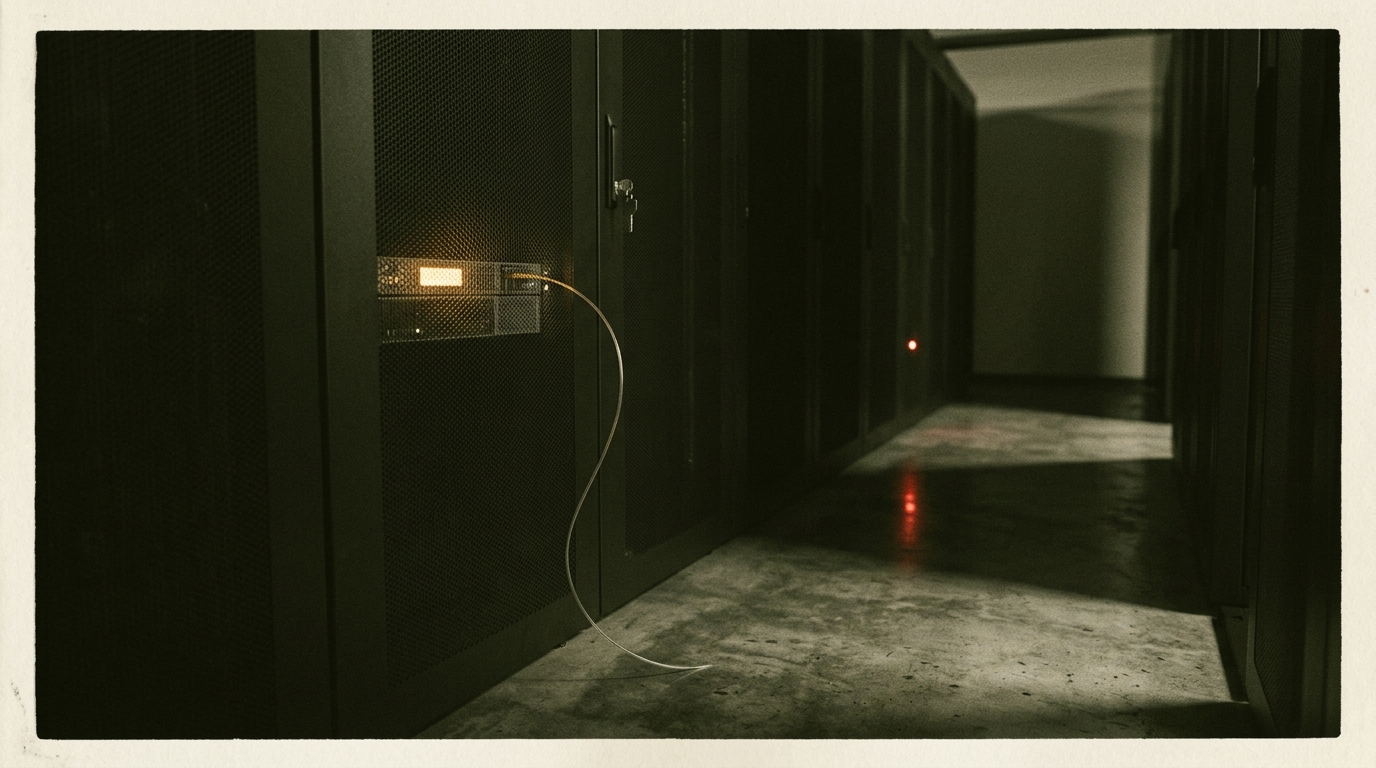
Every serious breach has a moment where the architecture itself hands over the keys. For thousands of VMware environments this month, that moment is a directory traversal in the syslog collector — the humble log server — that lets anyone with network access execute code as root on the vCenter Server Appliance. No credentials. No user interaction. No workaround.
Broadcom disclosed the flaw, tracked as CVE-2026-59310, on July 29. It carries a CVSS score of 9.8, and the rating is not ceremonial: the syslog service is reachable on the vCenter management interface, the flaw is a directory traversal that escapes its intended path, and the result is arbitrary code execution with the highest privileges on the appliance. In other words, the component that exists to record what happens on the network can be made to make things happen on the network.
By mid-August it was no longer theoretical. Incident responders began reporting active exploitation in the wild, with attackers landing on exposed appliances, establishing persistence through cron jobs, and deploying a reverse SSH tunnel — an outbound connection that slips past inbound firewall rules and gives the operator a durable path back in. The National Cyber Threat Intelligence alert flagged the campaign. The advice from everyone, including Broadcom, is the same: there is no workaround. Patch.
The Management Plane Problem
To understand why this bug matters more than its component suggests, you have to understand what vCenter is. It is not a workload. It is the control system for the workload — the pane of glass through which an administrator sees every virtual machine, every host, every network in the environment. Compromise vCenter and you do not get one server; you get the whole estate. Every virtual machine can be reconfigured, every disk copied, every credential harvested. It is the difference between breaking a window and getting the master key.
The syslog service sits on that same management plane. It was designed to be a passive listener — the appliance collects logs from the hosts it manages. But a listener that can be tricked into writing files outside its sandbox stops being passive. The directory traversal in CVE-2026-59310 does exactly that, and because the service runs with elevated privileges, the files it writes land with the authority of root.
This is the second act of a familiar play. The industry spent a decade hardening the hypervisor — ESXi — and it worked; direct hypervisor exploits are rare. But the management plane around it, the APIs and services that administrators touch, has become the preferred route in. The 2020 ESXi escalation chain, the 2023 vRealize outbreaks, and now the syslog flaw all follow the same geometry: skip the vault, take the guardhouse.
Reverse SSH, or How to Own a Firewall
The post-exploitation tradecraft in the observed campaigns is worth pausing on, because it is a masterclass in quiet. Once the traversal lands code on the appliance, the attackers install a cron job — the Linux scheduler, repurposed as a persistence mechanism. Every minute, the cron job checks whether the tunnel is alive. If it is not, it rebuilds it.
The tunnel itself is reverse SSH. Most firewalls are configured with a simple philosophy: inbound connections are suspect, outbound connections are business. Reverse SSH exploits that asymmetry perfectly. The compromised appliance initiates an outbound connection to attacker infrastructure, authenticates, and then presents that connection back to the operator as a tunnel — an interactive shell that arrives from the inside. No new inbound holes. No suspicious listening ports. From the firewall's point of view, the data center simply went browsing.
From the firewall's point of view, the data center simply went browsing.- Reverse SSH in one sentence
Defenders are not helpless, but the detection burden is real. The reverse SSH pattern leaves traces — outbound connections to unusual hosts on odd ports, cron entries referencing binaries in /tmp, SSH processes running as root without a controlling terminal. The blue-team writeups publishing Sigma and KQL rules for exactly these artifacts are the most useful thing written about this bug. But traces are not alarms, and a log server that has been captured is in a poor position to testify against its captor.
The Patch Gap Economy
Here is the uncomfortable part. The patch has existed since July 29. The exploitation began shortly after. That is not a contradiction — it is the standard rhythm of modern vulnerability economics. A patch is a disclosure; it tells everyone, including attackers, exactly where the door is and how it opens. The window between patch availability and patch deployment is where the damage happens, and for infrastructure like vCenter — the kind you schedule downtime for, coordinate across teams, and upgrade carefully because everything depends on it — that window is measured in weeks, not hours.
The attackers know this. Campaigns against freshly patched enterprise software are now effectively industrial: scan for exposed instances, check the version banner, exploit the stragglers. The syslog flaw is being worked exactly this way. Every day an unpatched appliance stays on the internet is a day it appears in someone's scanner output with a version number that reads like an invitation.
And the exposure question is not hypothetical. vCenter's management interface is meant to live on an internal network, reachable only by administrators. In practice, internet-scanning research has repeatedly found thousands of these interfaces facing the public internet — left there by convenience, misconfiguration, or the quiet drift of networks that grew faster than their documentation. Each one is a management plane with a welcome mat.
What This Means
- The log server is the front door. CVE-2026-59310 turns vCenter's syslog collector into an unauthenticated root shell — the observability plane is now part of the attack surface, whether anyone budgeted for it or not.
- No workaround means the patch gap is the story. With zero mitigations short of upgrading, the weeks between disclosure and deployment are the window attackers are actively working.
- Reverse SSH weaponizes the firewall's own logic. Outbound is trusted, so the tunnel comes from the inside — and a captured log server is in no position to testify against its captor.
The machine that watches the house has become the way in. Patch the log server — and while you are at it, ask why it was ever facing the street.