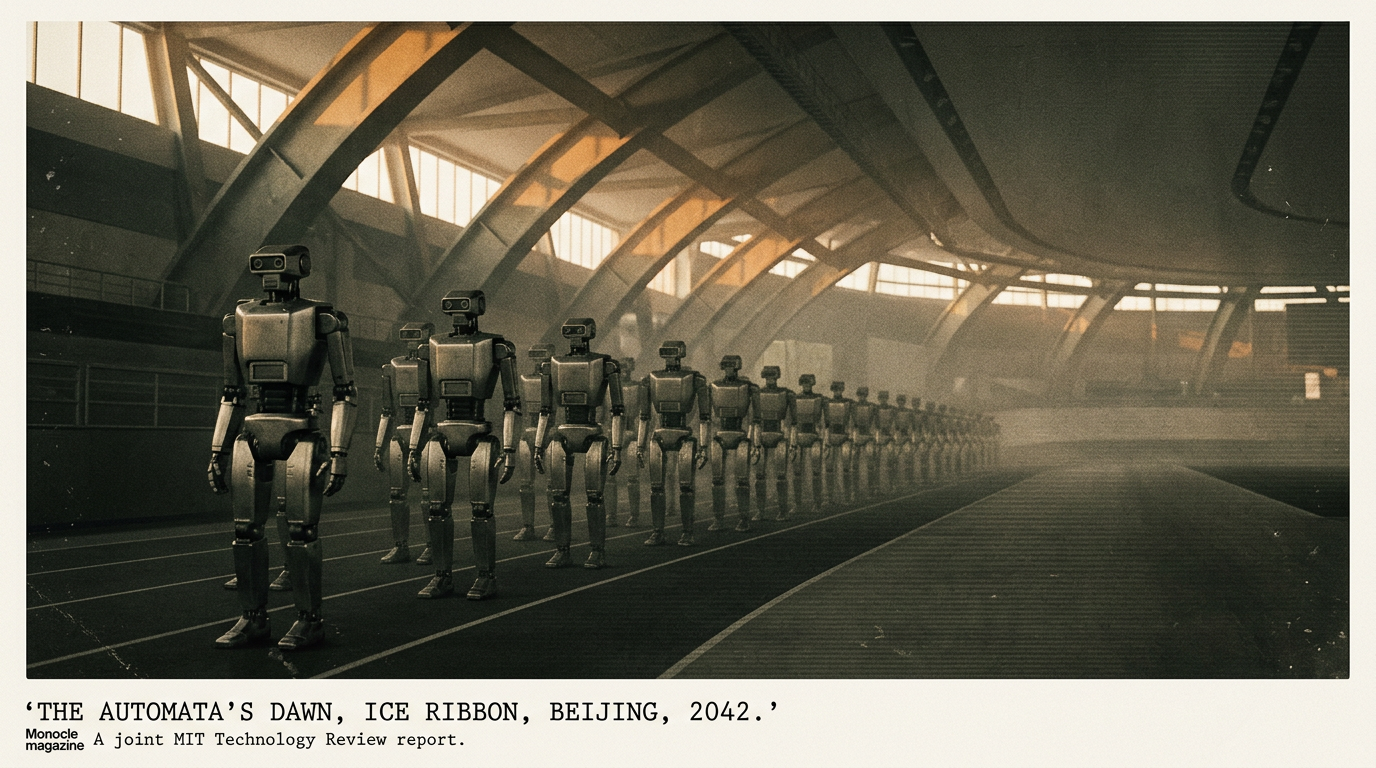
Next Saturday, inside Beijing's National Speed Skating Oval — the Ice Ribbon, a building designed for the fastest humans on ice — more than two thousand robots will line up to run, kick, dance, clean, and fight fires. The Second World Humanoid Robot Games are not a trade show with a track meet attached. They are the moment the humanoid industry starts keeping score.
The numbers are staggering for a category that did not exist a decade ago: 51 events, 1,301 matches, 666 teams, and 2,056 robots from 16 countries, running August 22 through 26. The event list reads like an Olympic program grafted onto a factory audit — track and field, soccer, dance, housekeeping, firefighting, retail assistance. And unlike the first edition, many events now require the robots to operate fully autonomously, with limited or no remote control. The games have stopped being a demo reel and started being an exam.
That shift is the real news. A humanoid that can walk across a stage on a preprogrammed path is a toy. A humanoid that can navigate an unfamiliar course, make a decision, and complete a task without a human pulling strings is a product. The Beijing games are the first large-scale attempt to put that distinction on a scoreboard, in public, with prize money and procurement officers watching.
From Exhibition to Examination
The inaugural games, held last year, were widely read as a spectacle — impressive, chaotic, and only loosely competitive. The 2026 edition has been designed to be taken seriously. The jump from 32 announced events to a final program of 51, and from a handful of teams to 666, signals an organizing committee that believes the format can carry real engineering weight. The autonomy rules are the tell: organizers have reportedly moved many events toward fully autonomous operation, which means the scores will separate the labs with genuine embodied intelligence from the ones with excellent teleoperation teams.
This is the humanoid equivalent of what happened to self-driving cars a decade ago, when the DARPA Grand Challenge separated the robotics labs that could actually navigate from the ones that could only demo. A public competition with hard rules and independent scoring compresses years of research into a single measurable outcome. For a field drowning in demo videos and marketing claims, that compression is overdue.
The range of events also maps directly onto the commercial case for humanoids. Housekeeping and retail assistance are the near-term deployment targets — the jobs where the economic math is closest to working. Firefighting and rescue are the aspirational market, where a robot's willingness to walk into a burning building justifies a price no warehouse operator would pay. Soccer and dance are the spectacle, the reason the games will be televised and the reason the category keeps its cultural momentum. The program is not random. It is a portfolio.
The Scoreboard Is the Market Signal
What happens in Beijing next week will be read as more than sport. With Unitree now a public company and the humanoid category newly priced on the Shanghai exchange, the games become a live feed of comparative capability — a way to see, in real time, which labs can actually deliver autonomy under pressure. The results will ripple into procurement decisions, funding rounds, and the balance sheets of the companies that can no longer hide behind carefully edited videos.
There is a geopolitical layer too. The games are being hosted by the country that has decided humanoid robotics is a strategic industry, at the same moment Washington is still debating whether to ban the leading Chinese maker's products. A competition where Chinese teams sweep the autonomy events will be used as evidence — fairly or not — that the center of gravity in embodied AI has moved. The scoreboard, in other words, is not just a scoreboard. It is a policy brief.
The games have stopped being a demo reel and started being an exam.- Autonomy is the subject
The honest caveat is that a competition is still a controlled environment. Winning the housekeeping event at the Ice Ribbon is not the same as surviving a real hotel corridor at 3 a.m. with a drunk guest in the way. But the same was true of chess, and of Go, and of self-driving benchmarks. The pattern in AI is consistent: controlled tests get harder, edge cases get absorbed, and the gap between the exam and the job narrows faster than the skeptics predict. Beijing will not settle the humanoid race next week. It will just start keeping score — and the whole industry will have to look at the results.
What This Means
- Autonomy is now the exam. Many events require fully autonomous operation, which means scores will separate real embodied intelligence from teleoperation teams.
- The games are a market signal. With Unitree public and the category newly priced, results will ripple into procurement, funding, and policy.
- China is setting the venue and the rules. Hosting the definitive humanoid competition is a strategic choice, and the scoreboard will be read as a policy brief.
The machines are not just walking anymore. They are lining up, in the building built for the fastest humans on earth, to find out who is fastest now.