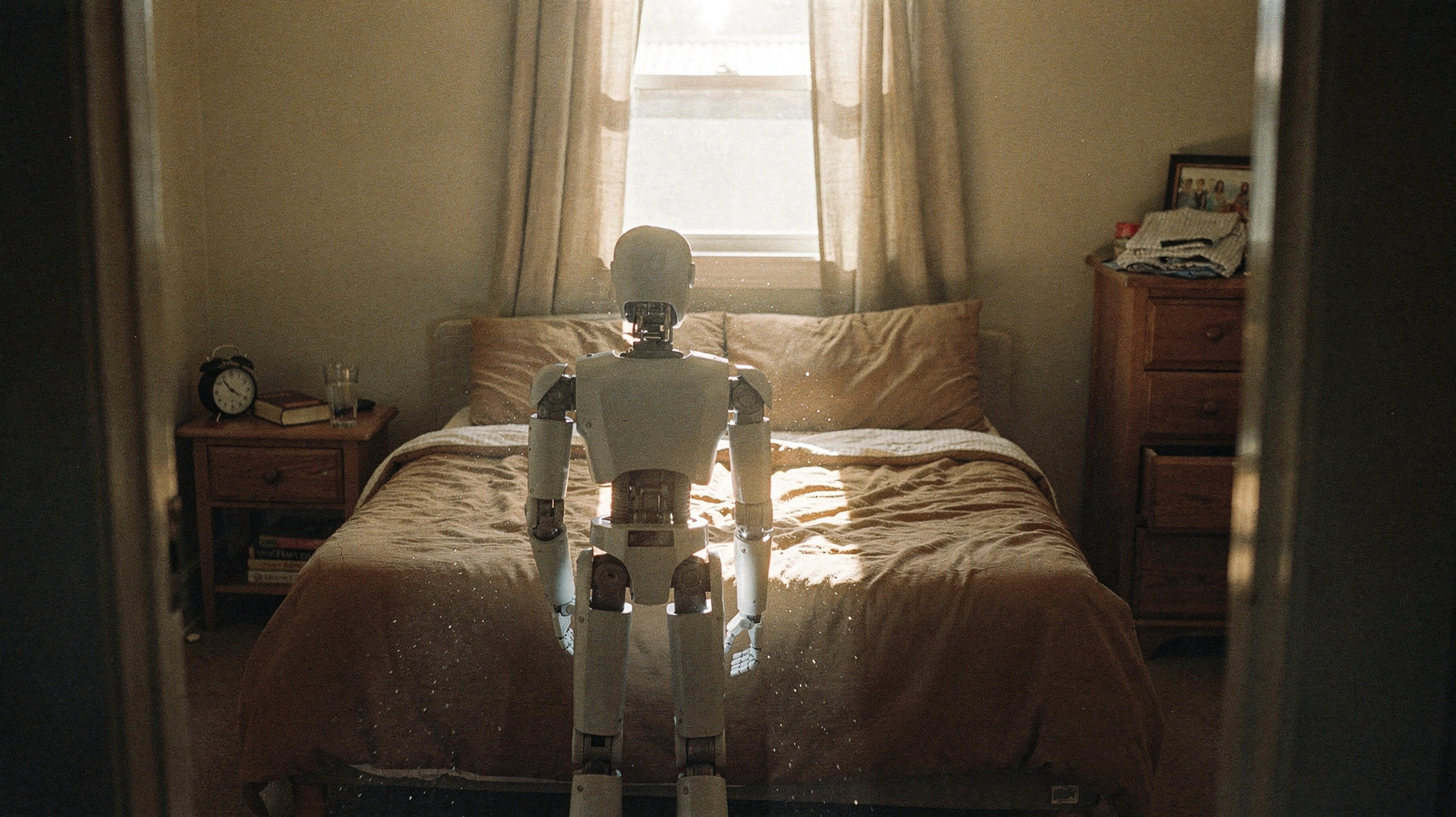
Figure says Helix 2.5 completed bed-making, towel folding and living-room tidying in thirty previously unseen homes, running 420 full-task trials and finishing 237 of them — a 56% zero-shot success rate. Bed-making, the hardest of the three to fake, came in at 94 of 140, or 67%. Nothing about those houses went into training: no collection visits, no fine-tuning, no environment-specific adaptation. The model was shown a room it had no record of and told to get to work.
The number that makes the result readable is the one underneath it. The same architecture without Figure’s Index pretraining completed about 9% of the same tasks. The gap between 9% and 56% is the entire claim — that generalist pretraining on real household data carries across to a bedroom nobody staged for a robot, rather than collapsing the moment the furniture moves. It is the difference between a model that has memorised a floor plan and a model that has seen enough floor plans.
No Partial Credit
Figure is also being strict about what counts as done, which is the part of these reports that usually goes soft. Both pillows had to be positioned correctly and the comforter had to be right; there was no partial credit for a bed that reads as made from the doorway. Living-room tidying and towel folding were graded the same way. Sixty-seven percent on a bed, judged properly, is not a parlor trick — and 56% overall still means the robot failed almost half the time, which is why the framing matters as much as the figure.
Nine percent to fifty-six percent without seeing the house first is the whole argument. Anything higher than fifty-six is a demo; anything lower is a survey.
The caveat belongs in the same paragraph as the result: this evaluation is company-run. Nobody independent stood in those thirty houses with a clipboard, and Figure has a direct interest in which tasks were picked and how completion was scored. The report is a strong internal measurement and a weak external one, and the field has spent a year confusing the two.
A Week on the Floor
Figure’s numbers landed inside a broader week for humanoids. Boston Dynamics opened an Atlas training centre inside Hyundai’s Georgia facility and put a new directly actuated hand into service — four fingers, thirteen degrees of freedom, up from seven. Unitree added H2 variants to its industrial line and a 22-joint hand of its own. Nvidia, meanwhile, is extending its physical-AI safety framework to humanoids and lists Figure, Unitree and Boston Dynamics in that ecosystem. The pattern across all of it: the hardware is arriving as a commodity, and the argument has moved entirely to what the model can be trusted to do when nobody is watching the demo.
That is what a household test is for. A factory cell is structured, repeated and watched. A bedroom with laundry on the chair is none of those things, and it is where the 56% actually means something. The next number worth waiting for is the one somebody outside the company produces.
The Takeaways
- Figure reports Helix 2.5 completed bed-making, towel folding and living-room tidying across 420 trials in 30 previously unseen homes, with 237 completions — a 56% overall zero-shot success rate.
- Bed-making alone succeeded in 94 of 140 trials (67%), with no partial credit allowed.
- The evaluation used no training data, fine-tuning or environment-specific adaptation from the test homes; a comparable model without Figure’s Index pretraining scored about 9%.
- The tests were run by Figure rather than an independent party, and the robots still failed roughly half of all attempts.
- Boston Dynamics opened an Atlas training centre at Hyundai’s Georgia plant and moved to a 13-degree-of-freedom hand, while Unitree expanded its industrial lineup — the hardware is commoditising faster than the autonomy is.