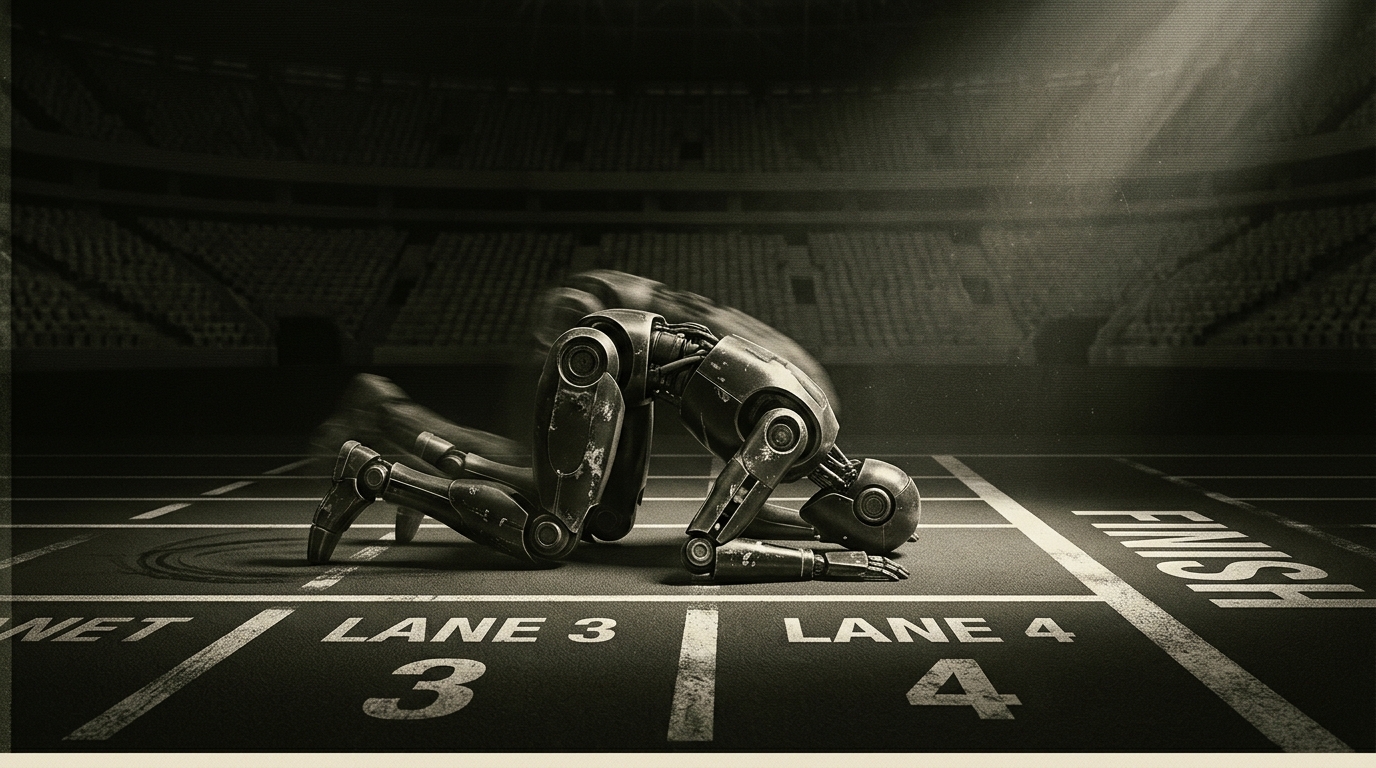
The market gave Unitree a number on Wednesday. On Thursday, the hardware gave one back. During a sprint test ahead of the Second World Humanoid Robot Games, which open in Beijing on August 22, a Unitree H1 lost control, veered off course, and collapsed — folding at the waist near the finish line, its midsection failing under the very loads that sprinting imposes.
The footage is brief and unglamorous, and that is precisely its value. A robot that had been billed at ten meters per second — a figure Unitree claimed in April, faster than any human alive — is shown doing the thing the highlight reels never include: failing in an ordinary way, in an ordinary place, at an ordinary speed test. No explosion, no dramatic malfunction. Just a machine whose structure gave out where structures give out.
The timing is the story. This happened inside the same week the company closed its first day of public trading up 460 percent, at a valuation near fifty billion dollars, and days before the Games where the H1 was expected to be a headliner. The gap between those two events — the ticker and the fold — is the entire humanoid industry compressed into forty-eight hours.
What Breaking at the Waist Actually Means
There is a reason the failure mode is so specific. The waist — the junction between the torso and the pelvis — is the worst structural job in a humanoid. Every force the legs generate has to pass through it; every mass the torso carries has to be held upright by it. In a human, the low back absorbs this punishment with a spine, a lattice of muscles, and a nervous system that continuously, unconsciously rebalances the load. In a robot, it is a handful of actuators and a structural member, tuned for a power-to-weight ratio that sprinting actively punishes.
Running is the most demanding thing a biped does. At speed, each footfall generates ground-reaction forces several times body weight, and the torso must be accelerated and decelerated with every stride while staying rigid enough to hold the sensors steady. When the control loop that manages all of this — the balance controller, in robotics terms — falls behind, the machine does not stumble like a human. It diverges. The gait oscillates, the correction arrives late, and the structural members take loads they were never meant to absorb in sequence. The fold is the result.
None of this is a scandal. Prototype race cars crash. Test aircraft stall. The failure is not the embarrassment; the failure is the data. What makes the clip matter is what it measures: the distance between what a humanoid can demonstrate in a controlled highlight and what it can survive in an ordinary afternoon of testing.
The Games Will Grade Everything
The World Humanoid Robot Games begin the day after tomorrow, and the crash lands as an unwanted prologue. More than two thousand humanoids from sixteen countries will compete across fifty-one events at Beijing's Ice Ribbon — sprints, obstacle runs, and scenario tasks, many fully autonomous. The 100-meter race is being run without human control this year, which means every entrant is executing its own balance controller in real time, in public, on camera.
That is the real stakes of the fold. The Games are not a trade show; they are a structured, adversarial environment designed to expose exactly the failure mode the H1 just demonstrated. A robot that cannot survive a speed test on Tuesday will not survive a competitive 100-meter sprint on Saturday. Every team in Beijing knows this, which is why the smart money at these events is rarely on the fastest machine — it is on the one that finishes.
The smart money at these events is rarely on the fastest machine — it is on the one that finishes.- The Games' real lesson
There is also a competitive wrinkle: Unitree enters its own machines while also supplying platforms to independent teams, a dual role the company has leaned into. When a house robot folds at the waist, the independent teams running the same hardware feel it too. Reliability is not a private virtue in this industry; it is a shared supply chain.
The Valuation Answers to the Hardware
Yesterday this page argued that Unitree's listing ended the era of comfortable ambiguity — that a public market imposes a live, trading discipline on the whole category. The fold is what that discipline looks like from the other side. A private company can bury a failed speed test. A public one trades at fifty billion dollars with the whole world watching its robots fall down, and the market's patience for highlight reels is shorter than a demo cycle.
The honest read is that both things are true at once. The technology is advancing at a genuinely astonishing pace — two-meter jumps, record sprints, three-month development cycles. And the machines still fold at the waist during ordinary testing. These are not contradictory observations; they are the same observation, made from two ends of the same engineering curve. The industry is climbing the steepest part of that curve, and the steepest part is where the falls happen.
What This Means
- Demo speed and survival speed are different numbers. The H1's April claim was ten meters per second; the fold happened at an ordinary test. The gap between the two is the industry's real maturity metric.
- The Games will grade all of it publicly. With a fully autonomous 100-meter event and 2,056 entrants, Beijing this week is the largest adversarial reliability test the field has ever run.
- Public money shortens the leash. A private company buries a failed test; a fifty-billion-dollar company answers for it. The fold is the first entry in Unitree's public-market reliability ledger.
The market priced the jump on Wednesday. On Thursday, the hardware priced the fall. Both numbers are honest — and the industry has to live with both now.