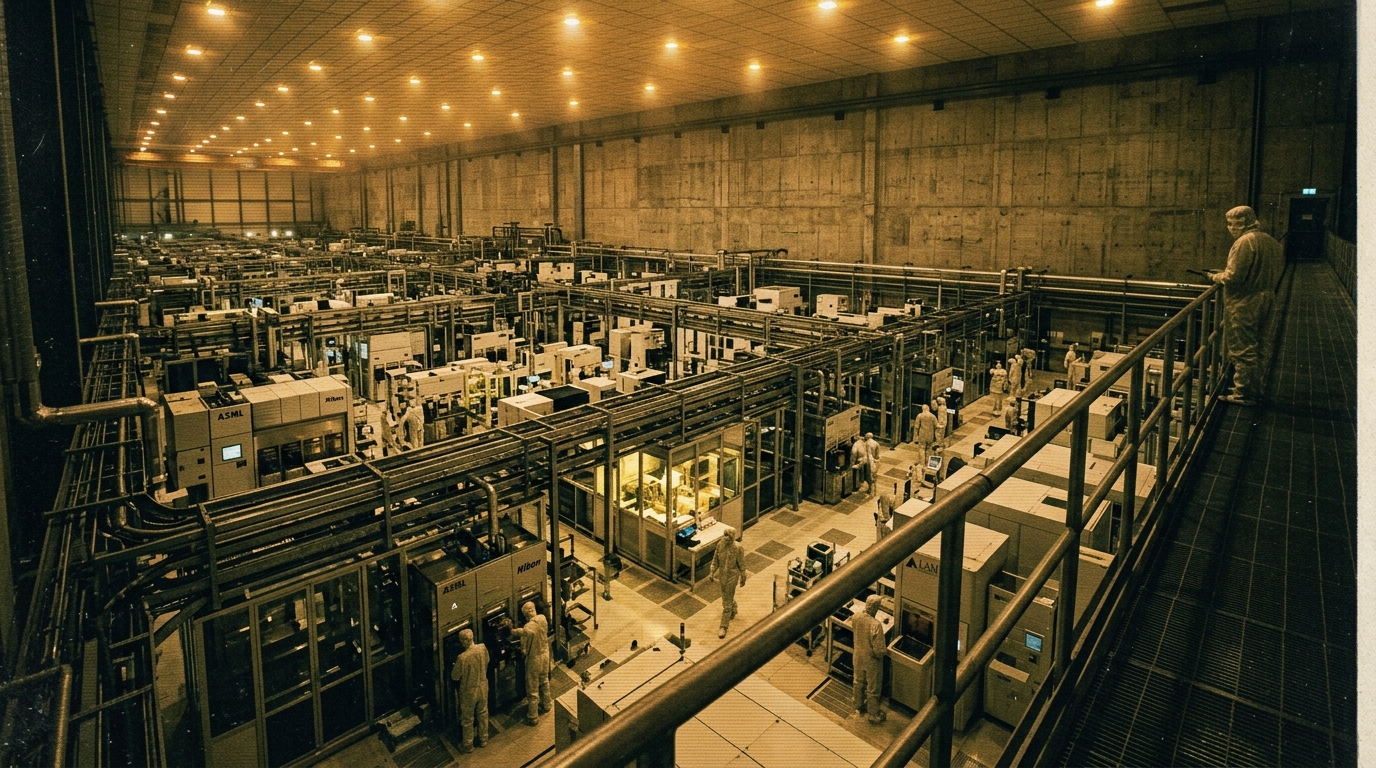
The most important factory in the world has a new message for its biggest customers: not everything. TSMC, whose leading-edge fabs produce nearly every advanced AI chip on Earth, has told Nvidia, Broadcom, and others that it cannot meet all of their demand for advanced processors. The AI buildout — the hundreds of billions of dollars in data centers, the race for the next model, the entire narrative of infinite compute — just hit a wall, and the wall is physics.
TSMC’s warning is not the usual supply-chain wobble. The company has spent the past two years expanding capacity at a pace the industry has never seen: raising capex, opening new fabs in Arizona and Japan, and still, according to reports, telling key customers that its most advanced production lines are spoken for. The constraints are not just wafer fabrication. Advanced packaging, equipment, power, even construction crews — the entire physical plant that turns silicon into the substrate of AI — is stretched thin.
Broadcom’s executives have said it too: TSMC capacity is a bottleneck that could limit chip supply well into the future. The company that makes the networking silicon for half the AI data centers in the world is telling investors that its own production is constrained by the same foundry that everyone else is lined up behind.
The Demand Is Real; the Fabs Are Not
Here is the counterintuitive part for anyone used to the AI hype cycle: the demand is not fake. For years, the bear case was that the AI bubble would burst because the models would disappoint; TSMC’s problem this week is the opposite. The demand is so real, so sustained, that even the foundry that owns advanced chips cannot build enough of them. The limit is no longer imagination, or venture capital, or even a novel architecture. The limit is how many wafers you can push through a cleanroom.
The news is the reveal of the bottleneck, not the creation of it. Nvidia’s next-generation Rubin platform is said to include six new chips for TSMC; the Feynman GPU is reported to target TSMC’s A16 process with volume production planned for late 2028. The line-up is real, the demand is real, and the factory that must build it all is telling everyone it cannot fit them all in the same shift. Every AI datacenter that gets built makes the next one harder to fill with silicon.
The Wall Is the Market
For years the AI trade has been a story about demand: the more models, the more compute, the more everything. The TSMC warning flips the narrative. The world is not worried about whether there will be enough AI; it is now worried about whether there will be enough silicon to run the AI the world has already ordered. The bottleneck is not the algorithm. It is the foundry, and the foundry is not getting bigger overnight.
The AI economy just discovered that its constraint was never compute, or models, or capital. It was the factory at the end of the line.— The physical wall
The response will be a scramble. Bigger capex from hyperscalers, longer lead times, consolidation around whatever fabs can deliver. The companies that placed their bets early — the ones with locked-in allocation, the ones that already own their silicon — will be the survivors. The ones that started late will learn that the AI land grab is not only about who has the best model; it is also about who is standing at the front of the line at the foundry.
What This Means
- The constraint is physical, not financial. AI’s growth engine is now gated by cleanroom floor space and the people who know how to run it.
- The plants move slowly. TSMC’s next nodes are measured in years, not quarters. Expect the silicon wall to outlast the models’ hype cycles.
- The winners are the early birds. Allocation is the new currency. The companies with locked-in capacity will shape what gets built — and what gets starved.
AI hit its first honest wall this week, and the wall is a factory in Taiwan. The buildout will go on — but the second half has a different physics to it.