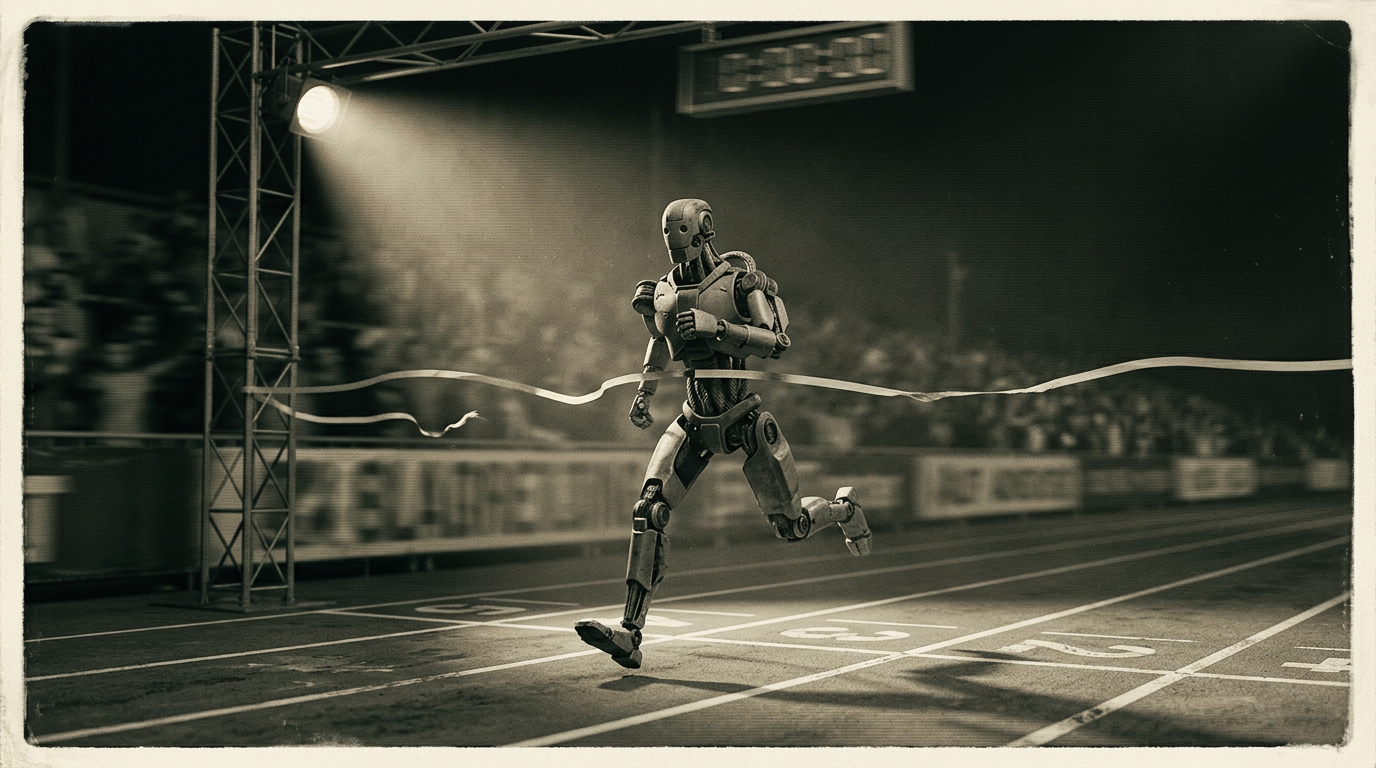
Usain Bolt's 100-meter world record has stood for seventeen years, through generations of sprinters who trained their whole lives to fall a hundredth short. It was broken this week in Beijing by a machine that has never trained, never feared the starting gun, and never once had to worry about the human in the next lane — because there wasn't one.
The numbers deserve precision, because the coverage has been loose with them. Lightning, a humanoid built for the World Humanoid Robot Games, clocked 9.32 seconds in a preparatory test — state media announced it, wire services repeated it, and the "robot beats Bolt" headline wrote itself. In the actual competition heats, Tiangong Ultra ran 9.39. Both times sit under Bolt's 9.58. Both are extraordinary engineering. And both were run alone, on a known surface, over a distance chosen precisely because it flatters what robots do best.
Peak speed, Lightning's developers say, hit 14.5 meters per second. Bolt's peak was around 12.4. On raw top-end, the machines passed humanity some time ago — Unitree claimed 12.66 m/s in a straight line last week without publishing protocols. Straight-line speed on a known surface is a solved problem. It was solved by wheels decades ago. The sprint record is the shiniest possible trophy for the least interesting capability in robotics.
The Wrong Benchmark
There is a reason the 100 meters became the benchmark. It is the most legible number in sport — one human, one distance, one clock. And legibility is exactly why it was the wrong wall for robots to attack first. Beating Bolt requires actuator power, balance control, and gait optimization. It does not require perception of an unstructured environment, adaptation to surprise, or any of the properties that separate a machine from a very expensive stopwatch.
The sector knows this, which is why the sharpest coverage this week asked a different question: robots can outrun humans, but can they plug in a cable? The mundane dexterity test — find the port, orient the plug, seat it without force — remains harder for a general-purpose humanoid than a sub-ten-second sprint. That asymmetry is the actual state of the field. Locomotion is a physics problem, and physics problems yield to engineering budgets. Manipulation is an intelligence problem, and intelligence problems yield to nobody's schedule.
What the Record Measures
Strip the ceremony away and the record measures this: Chinese humanoid engineering has reached the point where a purpose-built machine can, under controlled conditions, outperform the outer edge of human biomechanics in the one physical contest humans have optimized longest. That is genuinely a milestone. It is also a milestone of the same species as the chess victory — a demonstration that a sufficiently funded specialization beats general human excellence in a narrow frame.
The uncomfortable question is what the record was for. The Games are a state showcase; the record is a state headline. It converts an industrial-policy program into a sports story, which is the most efficient delivery mechanism for national-technological prestige ever devised. The 9.32 will travel further than any white paper. It will be believed by people who will never read a manipulation benchmark, and it will stand in the public mind for the entire field — a field whose honest practitioners spent the same week admitting the machines still can't reliably fold a box.
The clock measures the legs. It says nothing about the hands. And the entire commercial future of humanoids is in the hands.- On what 9.32 seconds does and does not certify
The Next Wall
The useful move now is to stop watching the sprint and start watching the dexterity events — the ones with no headlines, where machines grasp irregular objects, thread cables, and fail quietly. The gap between the 9.32 and the plug is the gap between demonstration and industry. Every warehouse operator, every factory integrator, every hospital procurement officer is pricing that gap right now, and none of them cares about the track.
Seventeen years from now, someone will note that Bolt's record outlived its human context and became a unit — the thing machines passed on their way to whatever came next. That is how benchmarks die: not defeated, but demoted. The sprint record fell this week. The plug is still standing. Watch the plug.
What This Means
- The record is real and it is the wrong benchmark. 9.32 in a test, 9.39 in a heat — both under Bolt. Both measure straight-line locomotion, the most solved problem in humanoid robotics.
- Speed was always going to fall first. It's a physics problem with a funding curve. Manipulation — the cable, the box, the cluttered shelf — is an intelligence problem with no schedule.
- Headlines are the payload. The 9.32 converts an industrial program into a sports story. It will define the field for the public far more accurately than the field deserves.
The machine ran 9.32 and the crowd cheered. Somewhere in the same venue, a robot was failing to plug in a cable. Only one of those two robots has a commercial future.