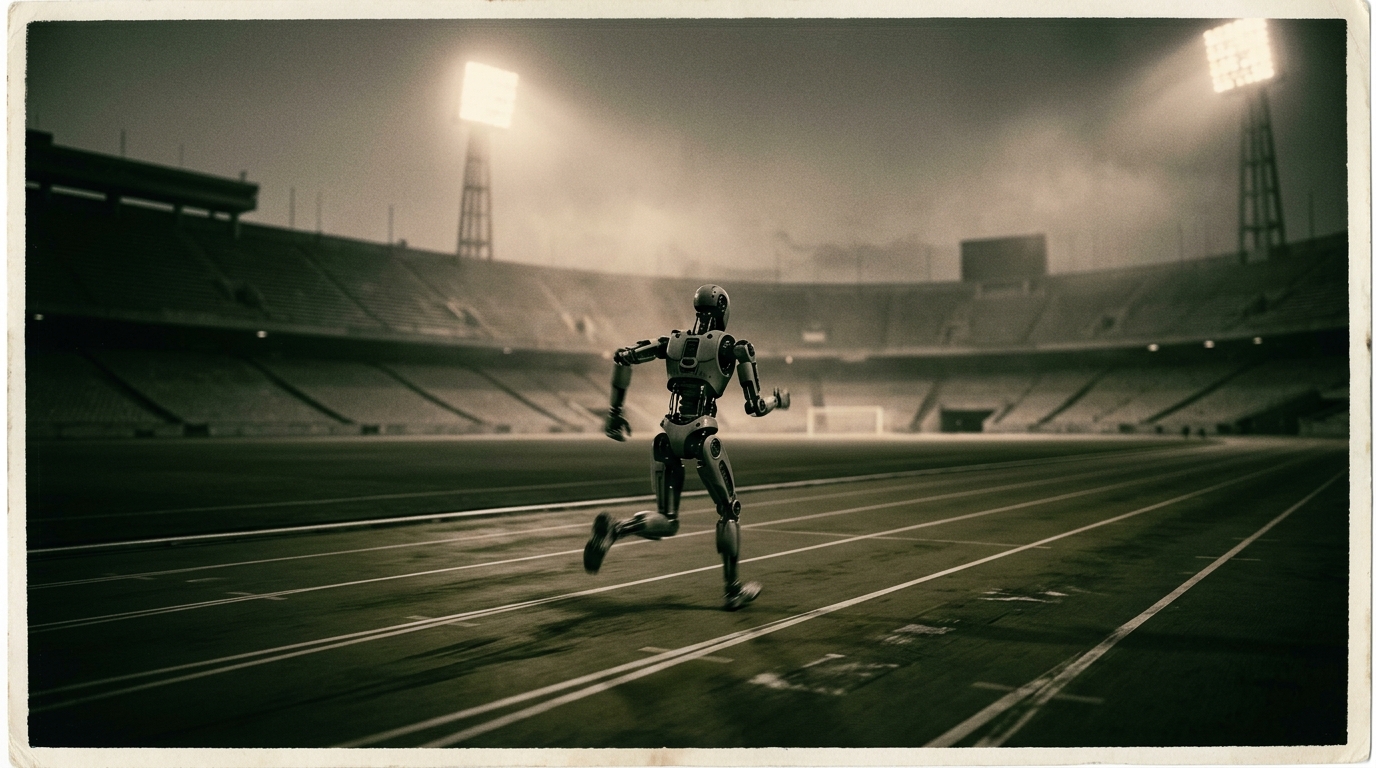
There is something perfectly 2026 about a robot Olympics. The World Humanoid Robot Games opened in Beijing this week with 2,056 robots from 666 teams across 16 countries and regions — a number that would have been a funding-round slide three years ago and is now a competitor list. The machines will run, jump, and presumably fall, on camera, for an international audience. It is the largest organized demonstration of humanoid capability ever assembled, and it arrives at the exact moment the industry's loudest showman is being asked to put a price on it.
The timing is the story. Unitree — the Hangzhou company whose backflipping, kung-fu-ing, two-meter-jumping machines have dominated the demo economy for two years — made its debut on the Shanghai stock exchange this week, drawing the kind of investor attention that turns a hardware company into a national narrative. The IPO boom across China's humanoid sector is real: manufacturing scale-up, global investor interest, and a government that treats robotics the way it once treated solar panels. The Games are the cultural expression of the same force. One is a stadium; the other is a ticker.
And then there is the confession. Unitree's founder, in the middle of the listing festivities, said what everyone in the field knows and no one in the marketing department permits: humanoid robots are not yet ready for mass real-world work. Humans still outperform them in most practical tasks. The machines that jump two meters vertically and hit 12.66 meters per second in a straight line cannot reliably fold a warehouse order. The gap between the demo and the job is the entire industry's unsolved problem, and it is being papered over, this week, with sport.
The Sport Solution
Competition is the oldest trick in technology for converting uncertainty into narrative. When you cannot prove a product works, you prove it performs. The Games' events — sprints, obstacle courses, dexterity trials — are chosen because they are measurable, legible, and dramatic. They are also, conveniently, adjacent to nothing a paying customer needs. A robot that wins a footrace has demonstrated actuator quality, balance control, and gait planning. It has demonstrated nothing about the last-mile problem of manipulation: grasping an irregular object in a cluttered space without breaking it.
This is not a criticism of the Games as spectacle. It is a criticism of the inference the market is invited to make. The leap from "medaled in Beijing" to "ready for the factory floor" is exactly the leap Unitree's founder declined to make this week, and he was right to decline it. The honest reading of the sector is that locomotion is largely solved, manipulation is partially solved, and reliability — the boring, untelevisable property of doing the same task ten thousand times without failure — is barely started.
The IPO Logic
Unitree's listing is the more consequential event, because capital is a harsher judge than a scoreboard. The Shanghai debut prices the company on the expectation that the demo economy converts to a product economy on some knowable schedule. The founder's honesty — not ready for mass real-world work — is the risk factor section of that prospectus, spoken aloud. Investors are not buying what the robots do today. They are buying a position in what Chinese industrial policy, component cost curves, and embodied-AI progress might converge to produce.
The sector's IPO boom says the market believes the convergence is coming. The founder's caveat says nobody knows when. Both can be true. What is not true is the soft story that the Games and the listing tell together: that capability is compounding in public, on schedule, and the only question is whose machines to buy. The actual open question — whether humanoids become general-purpose labor or remain specialized demo hardware with a sporting division — will be answered in warehouses and factories, off camera, over years.
The Games measure what the machines can do. The market measures what investors believe. Neither measures what a customer needs.- The gap between demo and job
What the Fall Means
There will be falls in Beijing this week — there already have been, on camera, during speed tests. The temptation is to read them as failure. The better reading is calibration. A robot that falls during a speed test is a robot being tested at the edge of its envelope, which is the only place worth testing. The dishonest footage is the flawless demo reel, cut and scored, of a machine performing a task it was tuned to perform that morning. Sport, whatever else it is, is unscripted. That is its entire evidentiary value, and the sector has been starved of exactly that.
So the Games are useful, just not in the way the coverage will claim. They will not show that the robot revolution has arrived. They will show, in public, under floodlights, precisely where the envelope ends — and every team in that stadium knows the falls are as informative as the medals. The market, meanwhile, will do what markets do with a good story and a scarcity of evidence: it will bid. The Shanghai ticker and the Beijing scoreboard are telling different stories about the same machines, and this week both are running.
What This Means
- The demo economy has institutionalized. 2,056 robots, 666 teams, 16 countries — competition is now the sector's primary public proof mechanism, which tells you how far from customer proof it still is.
- The founder's caveat is the prospectus. Unitree's own admission that humanoids aren't ready for mass real-world work is the most honest sentence in the entire IPO boom. Locomotion is solved; reliability is not.
- Falls are evidence. Unscripted failure at the edge of the envelope is worth more than a polished demo reel. Watch the falls, not the medals, for the real capability frontier.
Two thousand robots walk into a stadium. The interesting number is not how many finish. It's how many go home to a warehouse and get to work.