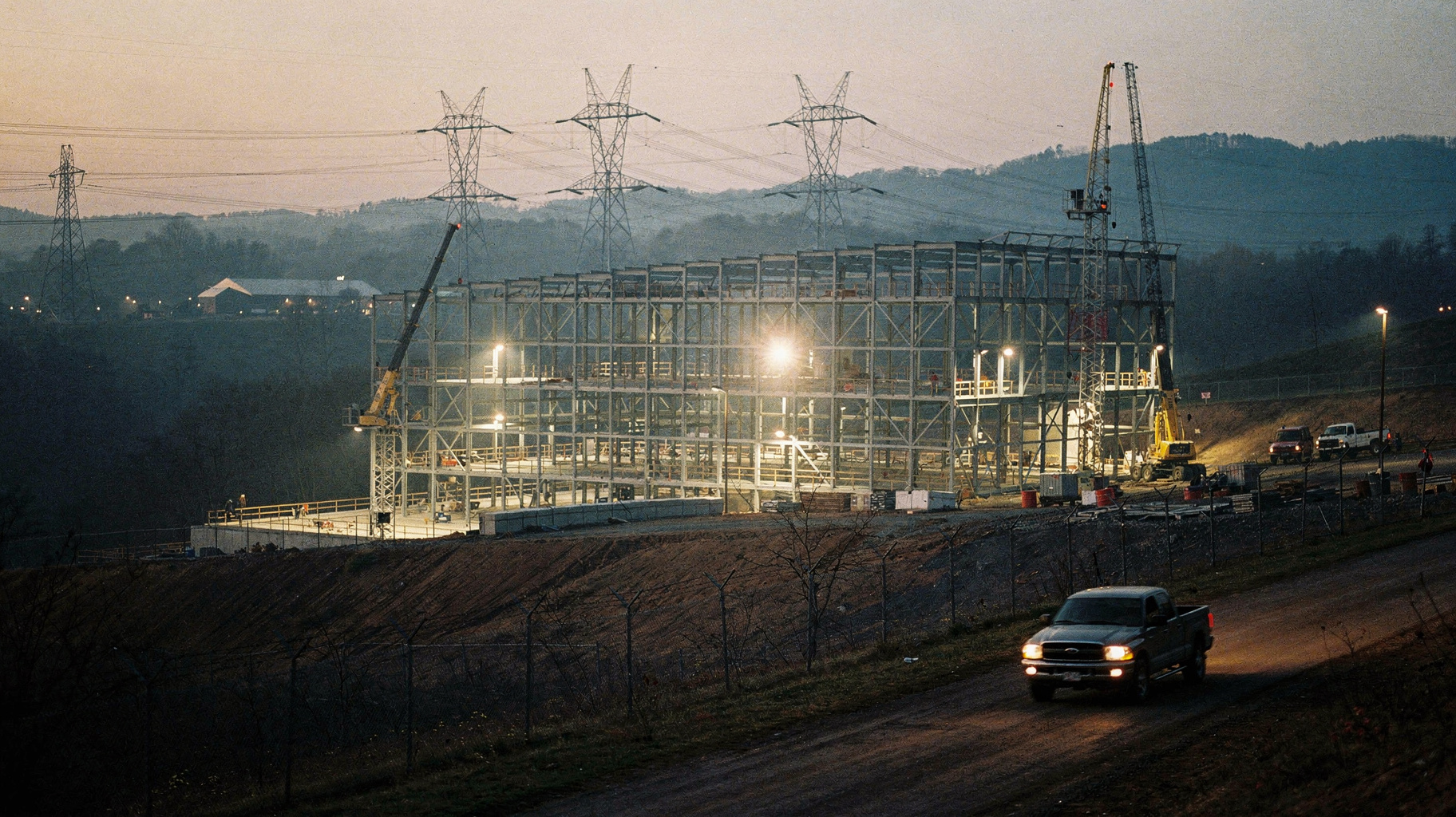
The largest AI deal of the year is not a model, a robot, or an acquisition. It is a utility bill. Bloomberg and CNBC reported Tuesday that Anthropic has agreed to pay Nscale — a British AI infrastructure firm most people had never heard of last year — roughly $45 billion over six years to rent computing power from a data center campus in West Virginia. The capacity: about 460 megawatts, enough electricity to power 345,000 American homes at once. The chips: Nvidia’s next-generation Vera Rubin platform, which is not shipping yet. The start date: late 2027. The buyer: a company that has never turned a profit, signing one of the largest compute leases in history to secure capacity more than a year before it exists.
The Deal on Paper
The numbers are worth slowing down for, because they describe a new unit of economic measurement. Six years. $45 billion. 460 megawatts at Nscale’s Monarch campus in West Virginia — the first building of a development that will reach 1.35 gigawatts when complete, with an on-site power plant, at a projected buildout cost of roughly $71 billion, of which about $47 billion is just the AI chips. Anthropic’s slice alone is comparable in scale to a national infrastructure program, and it is being spent on arithmetic. The deal is also, according to TechCrunch, tied to Nscale’s preparations for an initial public offering — an anchor tenant of this size is the difference between a speculative build and a financeable one.
And then there is the detail that gives the story its shape: Microsoft was there first. The company signed a letter of intent for the same West Virginia site in March, then walked away earlier this summer. The capacity did not sit idle for a quarter. It was re-let, at greater total commitment, to a frontier lab that considers compute a survival input. In the new market for intelligence, unused power is now re-allocated about as fast as unused concert tickets.
What the Money Is Actually Buying
It is tempting to read $45 billion as a bet on Anthropic’s models. It is more accurate to read it as a bet on scarcity. The frontier labs have learned, over eighteen months of rationing, that the binding constraint on intelligence is not talent or algorithms — it is megawatts. TSMC has told Nvidia and Broadcom it cannot build all the AI chips the market wants. The campuses that can deliver power are finite, permitted slowly, and contested by every lab at once. Anthropic already runs on AWS Trainium chips, Google TPUs, and its own Nvidia capacity; adding a dedicated 460 megawatts is not redundancy. It is the physical plant of a company that intends to exist in 2032.
The chip choice tells the same story from the other side. Vera Rubin is Nvidia’s next platform — the successor line to the Blackwell generation now straining global supply. Anthropic is not buying today’s compute. It is buying a claim on the 2027-and-later production of the most contested silicon on Earth, priced today, before anyone else can sign for it. This is what commodity hedging looks like when the commodity is thinking.
The Honest Reading
There are two ways this deal gets remembered. In the first, it is the moment the AI buildout peaked — a $45 billion lease signed by a money-losing company for chips that do not exist, against demand that has not arrived, a monument to the same over-ordering instinct that has cratered every infrastructure cycle since canals. In the second, it is boring: the moment frontier compute stopped being something you rented from a cloud and became something you underwrote, the way airlines underwrite aircraft and utilities underwrite plants. The honest position is that both readings are live, and the deal is precisely calibrated to be unrewarding to anyone who wants certainty before 2028.
What is already certain is the structural shift underneath it. The hyperscaler duopoly that Anthropic was built on — Microsoft’s money, Amazon’s chips — is no longer the only shelf. A startup lab can now go to a third-party builder like Nscale, lock a decade of power in Appalachia, and finance the counterparty’s IPO in the process. The cloud is fragmenting into a market of dedicated campuses, and the currency of that market is not features or uptime. It is megawatts, signed early.
The binding constraint on intelligence is not talent or algorithms. It is megawatts.— house, on the compute market
What the Power Bill Teaches
Every previous platform shift rewarded the companies that abstracted hardware away. This one is rewarding the companies that buy it back. Anthropic’s $45 billion is the tuition for that lesson: the labs that treated compute as a metered utility are now discovering it behaves like land — finite, titled, and appreciating in exactly the years they need it most. The next time a frontier lab announces a model, the interesting number will not be its benchmark score. It will be the size of its power bill, and how many years of it the company had the nerve to sign for in advance.
What This Means
- The deal is a hedge on scarcity, not a bet on a model. $45B over six years for 460 MW at Nscale’s Monarch campus in West Virginia — Vera Rubin silicon, online late 2027, tied to Nscale’s IPO preparations.
- Microsoft walked; the capacity did not cool. A March letter of intent lapsed over the summer and the site re-let to Anthropic within a quarter — unused AI power now reallocates like a scarce commodity, because it is one.
- The cloud is fragmenting into dedicated campuses. Between TSMC’s capacity wall and the hyperscalers’ queues, frontier labs are underwriting their own power plants. The currency of the intelligence market is megawatts, signed early.
Forty-five billion dollars for electricity that arrives in 2027, running chips that are not shipping yet, on land Microsoft declined. That is what it now costs to believe the next decade of AI — and Anthropic paid it without blinking, because the alternative was believing someone else’s queue position.