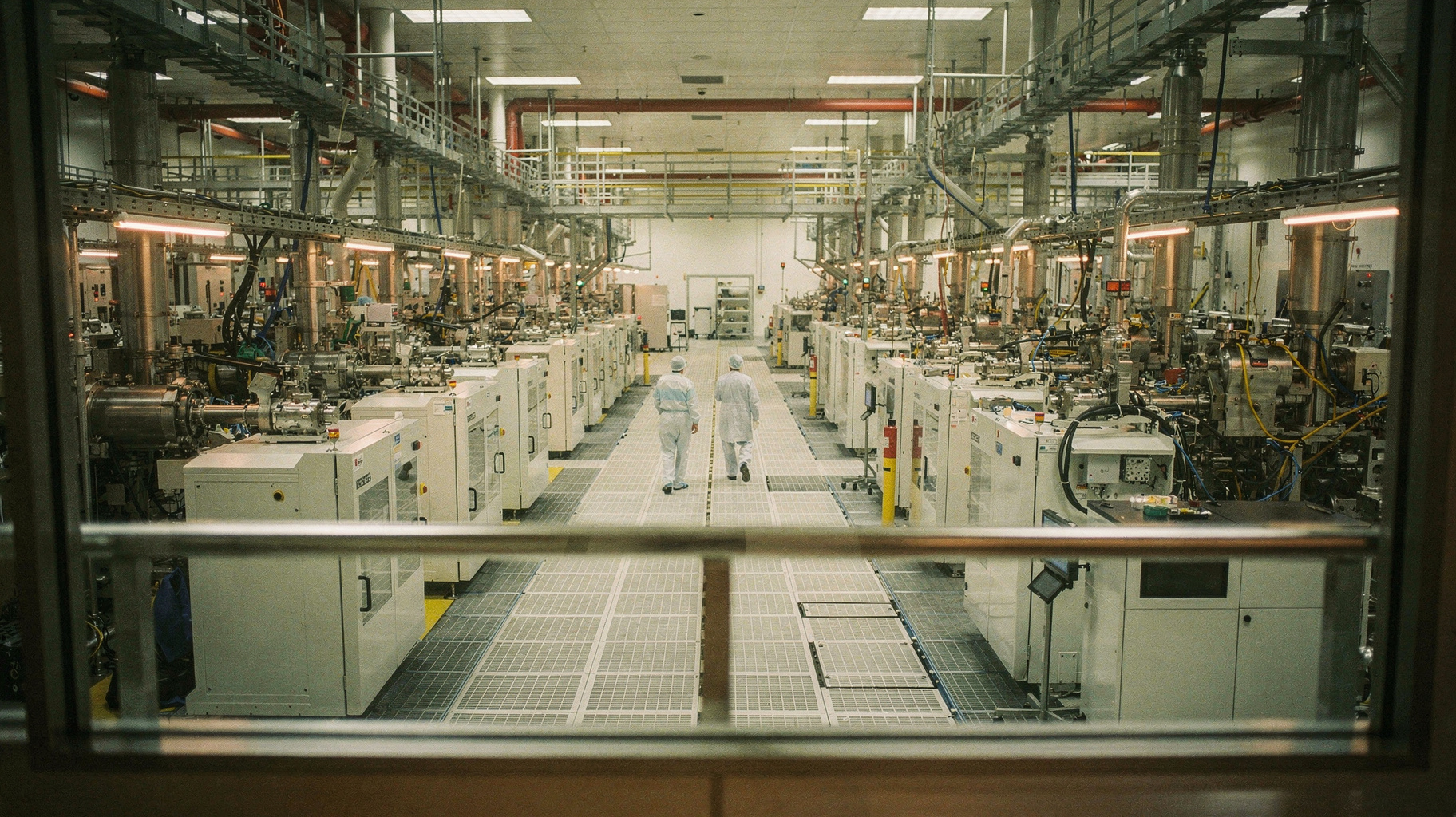
The announcement out of Nvidia’s GTC Taipei on Monday closes a loop that has been forming all decade: TSMC, the company that manufactures nearly every AI accelerator on earth, is putting AI to work inside its own fabs. The joint announcement with Nvidia covers the whole production spine — computational lithography on cuLitho, transistor and process simulation, advanced process control, factory scheduling running on H200s, nanometer-scale defect inspection via vision AI, electronic-structure simulation for materials research — with the two companies citing improvements of 20 to 50 percent in cost efficiency and cycle time on lithography, the single most expensive step in the process. TSMC is also evaluating Omniverse for FabTwin, its virtual-factory initiative. The fabs are becoming a customer of their own product.
The numbers deserve unpacking, because lithography is where the money burns. Computational lithography — the simulation of how light shapes the features on a wafer — has been a CPU supercomputing problem for two decades, and it consumes an enormous share of a leading-edge fab’s compute budget. Moving it onto GPU acceleration with claimed 20-to-50-percent gains in cost or cycle time does not merely speed a step; it changes the economics of the most capital-intensive process in the industrial world, at the exact moment AI demand has every leading-edge node sold out for quarters ahead. A faster fab is a supply response to the shortage the AI boom itself created.
The quieter items may matter more. Factory scheduling on H200s means the fab’s own logistics — which lot goes where, when — is now an AI workload. Process control via machine learning means the tool parameters that decide yield are tuned by models. Metropolis-class vision inspection at nanometer scale means the defect review that once bottlenecked on human eyes now runs continuously. Each is a small automation with the same shape: the manufacturing of intelligence is being handed to intelligence, stage by stage, with yield and throughput as the proof. This is how a recursive claim stops being rhetoric — not one dramatic self-improving loop, but a hundred individual line items that happen to point the same direction.
The Loop Question
The strategic reading writes itself, and it cuts two ways. For Nvidia, every efficiency TSMC gains in GPU-accelerated production lowers the cost of the next generation of GPUs — the vendor of the boom now supplies the machinery of its own supply curve, a position no industrial company has held at this scale. For everyone else, the loop raises the question the slowdown weekend left open: if AI is now load-bearing in the production of AI — not just in design, where it has been for years, but in scheduling, inspection, and the economics of lithography itself — then a frontier slowdown is no longer a pure capability question. It is a question about the industrial base, and Germany had a word for that on Monday: sovereignty.
What to watch next is adoption velocity, not the press release. TSMC has used Nvidia tooling in pieces of its workflow for years; what is new is the breadth — the whole spine, formalized, announced at GTC Taipei with FabTwin on the roadmap. If the claimed lithography gains show up in TSMC’s cost structure over the next two quarters, every other leading-edge fab follows, because they must. The fabs learned to think. The interesting question is what they decide to want.
The Takeaways
- TSMC is putting Nvidia’s AI stack across its fabs: lithography, process control, scheduling on H200s, nanometer defect inspection, and materials simulation — announced at GTC Taipei.
- Claimed 20–50% gains on computational lithography attack the most expensive step in chipmaking, a supply response to the shortage the AI boom created.
- The recursive loop is now industrial: AI accelerates the production of AI hardware, which concentrates advantage further in the loop’s owners.